Buying Your First Home in North County San Diego: Two Moves That Could Help You Get There Sooner

Buying Your First Home in North County San Diego: Two Moves That Could Help You Get There Sooner

You save a little more, check the listings, and do the math again. Somehow, buying a home still feels like something you’ll be ready for “in a few years.”
If that sounds familiar, you’re in good company. Especially here in North County, where the place you want to call home and the payment you feel comfortable making don’t always line up.
Maybe you’ve assumed you need a six-figure down payment. Maybe every home you’ve saved has the updated kitchen, extra bedroom, and backyard you eventually want. Or maybe you haven’t talked to a lender because you’re pretty sure the answer will be, “Come back when you’ve saved more.”
Before you rule yourself out, it helps to revisit two parts of the plan.
A recent Keeping Current Matters article highlights two ways buyers may shorten their path to ownership: choosing a starter home and exploring a down payment below 20%. Let’s take those ideas further and look at what they could mean for buying your first home in North County San Diego.
1. Give your first home a different job than your forever home
Your first home needs to work for the life you have now and the budget you can sustain.
It doesn’t necessarily need to accommodate every version of your future.
That’s easy to say and harder to remember when you’re scrolling through beautiful listings. Suddenly, the extra bedroom becomes essential, the kitchen needs to be move-in perfect, and a home without a large yard feels like a compromise you shouldn’t have to make.
Try asking a different question: What would make this a good place to live for the next several years?
For one buyer, that could be a two-bedroom condo with a manageable commute. For another, a townhome with a small patio. Someone else may prefer a smaller detached home with an older kitchen they can update gradually.
When buying your first home in North County San Diego, it can help to compare property types across Carlsbad, Oceanside, Vista, San Marcos, and Escondido. Use actual listings and complete monthly cost estimates to see where your budget stretches, rather than assuming one city or property type will always be less expensive.
Separate the things you need from the things you’d enjoy
Start with three lists:
- Must-haves: The bedrooms you actually need, accessibility requirements, workable parking, and a location that fits your daily routine.
- Preferences: Updated finishes, extra storage, a larger outdoor space, or a particular neighborhood.
- Things you can change: Paint, cabinet hardware, light fixtures, and other improvements you can reasonably afford over time.
Be specific. “A place for the dog” could mean a private yard, a patio, or access to a walking route, depending on your needs. “Room to work from home” might mean a dedicated office or a layout that comfortably fits a desk.
You’re deciding which features deserve your money now.
Also, a starter home doesn’t have to be a fixer-upper. A lower price is less helpful if the property immediately needs repairs you cannot fund. Review its condition before counting on inexpensive cosmetic updates.
What does the research actually say?
Zillow’s August 2026 analysis estimated a national timeline of 14.7 years to save a 20% down payment on a typical single-family home and reach financial break-even compared with renting. Its starter-home scenario had a combined timeline of 7.2 years.
Those figures include both the savings period and the years of ownership needed to break even. They are not estimates of how long every buyer must wait to purchase.
The analysis also uses different rental comparisons for the two scenarios and assumes savings equal to 10% of the area’s median income. Local results vary substantially. Treat the research as a reason to investigate a lower purchase price, rather than a prediction for your own finances.
2. Find out whether you actually need 20% down
The 20% down payment idea stops plenty of buyers before they ever ask about their options.
A larger down payment can have advantages. But 20% is not a universal requirement to buy a home.
For eligible borrowers, Fannie Mae’s HomeReady program allows down payments as low as 3%. Qualification includes income and other requirements, so this option isn’t available to everyone.
FHA loans can allow a down payment as low as 3.5% for qualifying borrowers. They also require mortgage insurance, which needs to be included when comparing costs.
Eligible buyers using a VA-backed purchase loan may be able to buy without a down payment, subject to entitlement, lender requirements, and the relationship between the purchase price and appraised value. VA loans do not require monthly mortgage insurance, although a funding fee may apply.
A lender can help you compare the programs you qualify for and explain how each changes your upfront costs and monthly payment.
Here’s what different down payments look like
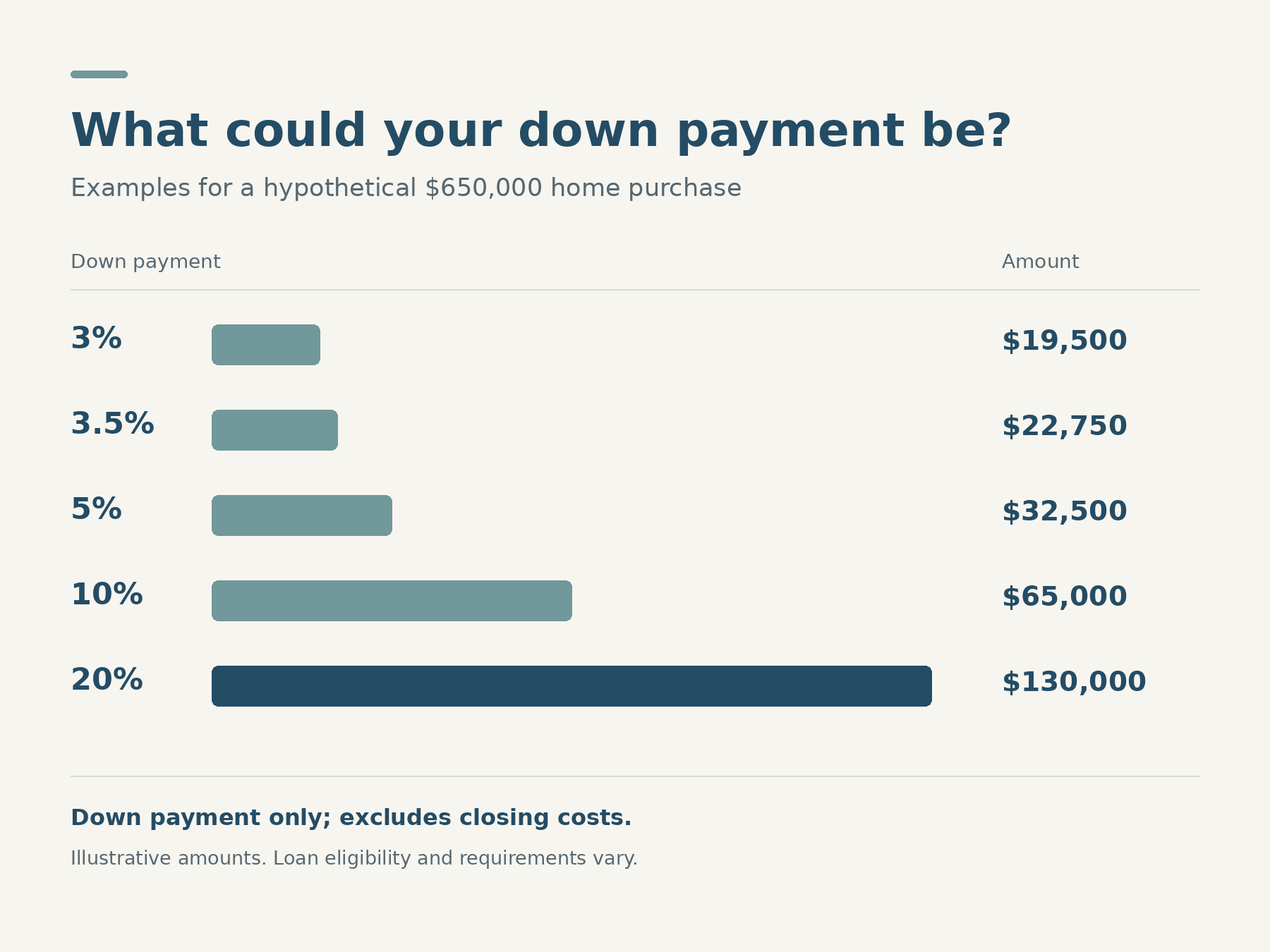
Using a hypothetical $650,000 purchase price:
| Down payment percentage | Down payment amount |
|---|---|
| 3% | $19,500 |
| 3.5% | $22,750 |
| 5% | $32,500 |
| 10% | $65,000 |
| 20% | $130,000 |
This is an illustration, not a statement about current North County listing prices or loan eligibility. These amounts cover the down payment only.
Still, the difference is meaningful. Saving $130,000 and saving $32,500 are very different goals.
That doesn’t automatically make the smaller down payment the right choice. It does make the question worth asking.
A smaller down payment comes with a tradeoff
With less money down, you generally borrow more. That can increase your monthly principal and interest payment compared with a larger down payment at the same interest rate.
Conventional loans with less than 20% down typically require private mortgage insurance, or PMI. PMI protects the lender if you default; it does not insure your home or protect your belongings.
Ask your lender to put several down payment scenarios side by side. Compare the monthly payment, mortgage insurance, closing costs, and cash remaining after closing.
For someone researching how to buy a home with a low down payment, the useful answer is a complete budget. You want to know what gets you into the home and what lets you comfortably stay there.
Budget for more than the down payment
Buying your first home in North County San Diego involves two separate planning questions:
How much cash do I need to purchase, and how much will ownership cost each month?
The down payment is only one part of the first question.
Closing costs are the expenses associated with obtaining the mortgage and transferring ownership. Your lender’s Loan Estimate outlines projected loan costs, other closing expenses, and estimated cash to close. Review it carefully and ask about anything you don’t recognize.
You’ll also want to plan for moving, any immediate purchases or repairs, and the savings you intend to keep available after closing.
A home purchase feels very different when you still have room for an unexpected expense.
Look beyond the payment on the listing app
For your own planning, make a worksheet that includes:
- Mortgage principal and interest.
- Property taxes and any applicable additional assessments.
- Homeowners insurance.
- Mortgage insurance, if required.
- HOA dues, if applicable.
- Utilities and a maintenance allowance.
Ask which expenses are included in the lender’s payment estimate and which you will pay separately.
If you’re comparing condos and townhomes, look carefully at the association documents, budget, reserves, insurance, and any existing or proposed special assessments. Ask what the dues cover and what remains your responsibility.
A condo with a lower asking price and higher HOA dues may have a similar monthly cost to a more expensive property. Run the comparison before deciding which one fits.
Ask about California down payment assistance
If upfront savings are your biggest obstacle, ask a lender about first-time homebuyer assistance programs.
CalHFA’s MyHome Assistance Program offers eligible buyers a deferred-payment junior loan that can help with down payment and/or closing costs when paired with an eligible CalHFA first mortgage.
Its published guidelines include first-time buyer requirements, income limits, primary residence occupancy, homebuyer education, and eligible property requirements. Buyers apply through approved lenders.
Deferred payment means repayment is postponed. It does not mean the assistance is automatically a gift.
Before using any assistance program, ask:
- Do I qualify based on income, ownership history, and the property?
- How much assistance could I receive?
- Does the assistance accrue interest?
- When would repayment be required?
- What happens if I sell or refinance?
- How does the combined financing compare with a loan without assistance?
Check current terms and funding availability before building your purchase plan around a program.
Think about how long the home will work for you
A starter home should be a place you can realistically live in for several years.
Buying comes with transaction expenses, and selling later has costs of its own. A quick move can make the financial picture harder, especially if the market hasn’t moved in your favor.
Think through the parts of your life that could change: your job, commute, household size, accessibility needs, or desire to relocate.
You don’t need to predict everything. But if a home already feels too small, too far away, or financially uncomfortable before you buy it, calling it a “starter” probably won’t solve that.
Also, avoid making the purchase depend on a future refinance or a certain amount of appreciation. Build your plan around the payment you can afford today.

A practical starting plan for first-time buyers
If you’re ready to explore buying your first home in North County San Diego, start here:
- Choose a comfortable monthly housing budget. Include your existing obligations and the things you want to keep doing.
- Talk with a lender about your current position. Ask about qualifying loan options, upfront costs, and what could improve your application.
- Request more than one down payment scenario. See how putting less down changes both your payment and remaining savings.
- Compare property types and locations. Review homes that meet your actual needs, then calculate their full costs.
- Check assistance eligibility early. Find out whether a program could fit before relying on it.
- Make a plan for your next step. That might be touring homes, saving toward a specific target, or working on a lender-identified obstacle.
Sometimes the answer is that you’re closer than you thought. Sometimes it’s that you need more time, but now you know exactly what you’re working toward.
Both are more useful than wondering.
Let’s see what buying your first home could look like
You don’t have to arrive with a preapproval letter and a perfectly organized spreadsheet to start a conversation.
“I’m renting, I’ve saved this much, and I’m curious whether buying is realistic” is plenty.
We’ve called Carlsbad Village home for more than 40 years. We can help you explore homes in Carlsbad and throughout North County, understand the tradeoffs between properties, and connect with a lender to review your financing options.
Curious what your budget could buy? Reach out with the areas you like and the monthly payment you’d feel comfortable with. We’ll help you figure out a useful next step.
Sources
Categories
Recent Posts







GET MORE INFORMATION